
Broker Licensing Overview and Requirements
Requirements to Become a California Broker
Applicants wishing to secure a real estate broker’s license must qualify in two categories:
Education and/or Experience & Statutory courses
Education and/or Experience
Effective January 1, 2013, broker applicants must have a minimum of two years full-time salesperson’s experience within the last five years, or two years of unlicensed experience, or a four-year degree from an accredited college or university that includes a major or minor in real estate. Further information on this topic can be found on the DRE website and in our Frequently Asked Questions (FAQs) below.
Statutory Courses
Applicants must have successfully completed at least eight statutory-required college level courses from the following list:
Five required courses
- Real Estate Practice
- Legal Aspects of Real Estate
- Real Estate Finance
- Real Estate Appraisal
- Real Estate Economics or General Accounting
Three of these courses*
- Real Estate Principles
- Real Estate Property Management
- Real Estate Office Administration
- Escrows
- Business Law
- Mortgage Loan Brokering & Lending
- Advanced Legal Aspects of Real Estate
- Advanced Real Estate Finance
- Advance Real Estate Appraisal
* Only the courses in bold are offered by Chamberlin Real Estate School.
** If applicant completes both Accounting and Economics, only two courses from second group are required.
Multiple Courses
Two to eight courses at the same time:
$89.00 for the first course plus only $65.00 for each additional course (make selections below)
*Multiple course discounts are on a per-student basis.
Time to Complete Courses
The California Department of Real Estate allows a course to be completed in a minimum time of 2 1/2 weeks per course (18 calendar days) from the date you receive your material. The maximum time allowed for completion of your course(s) is 1 year from the date of enrollment.
Number of Courses
Minimum Completion Time
1 Course
2 1/2 weeks
2 Courses
5 weeks
3 Courses
7 1/2 weeks
4 Courses
10 weeks
5 Courses
12 1/2 weeks
6 Courses
15 weeks
7 Courses
17 1/2 weeks
8 Courses
20 weeks
How Courses Work
High Quality Content
Our online courses use the same high quality content you would expect from a college level textbook. The content is then delivered entirely over the Internet through an engaging and interactive format.
The Chamberlin online courses will better prepare you to take and pass the California State Examination as compared to traditional home-study offerings. Sample questions similar to those you will encounter on the state exam are drawn from a database and distributed throughout the courses.


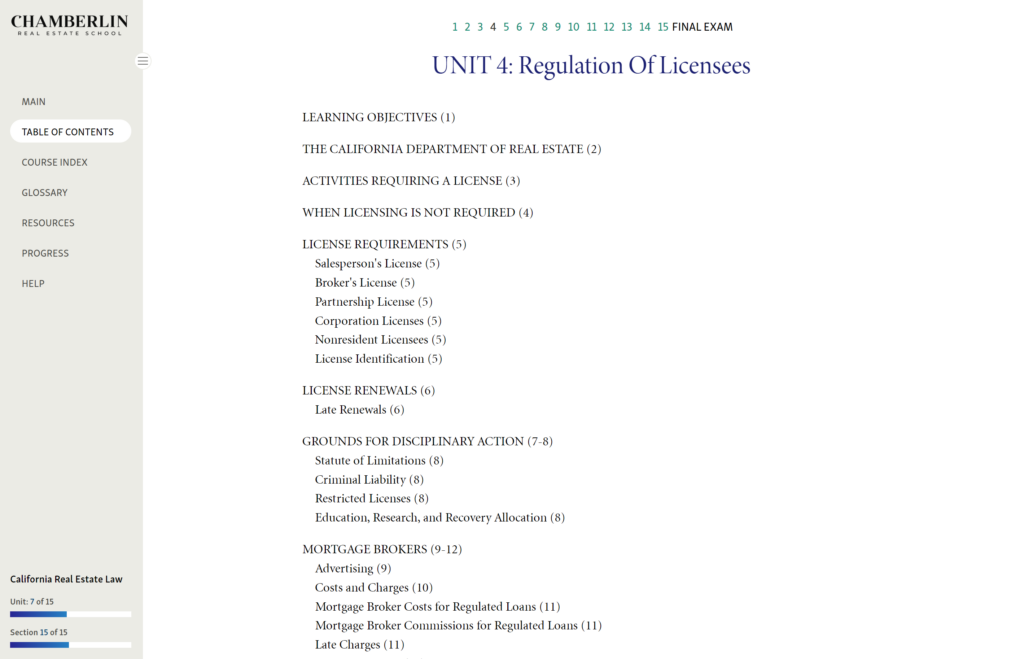


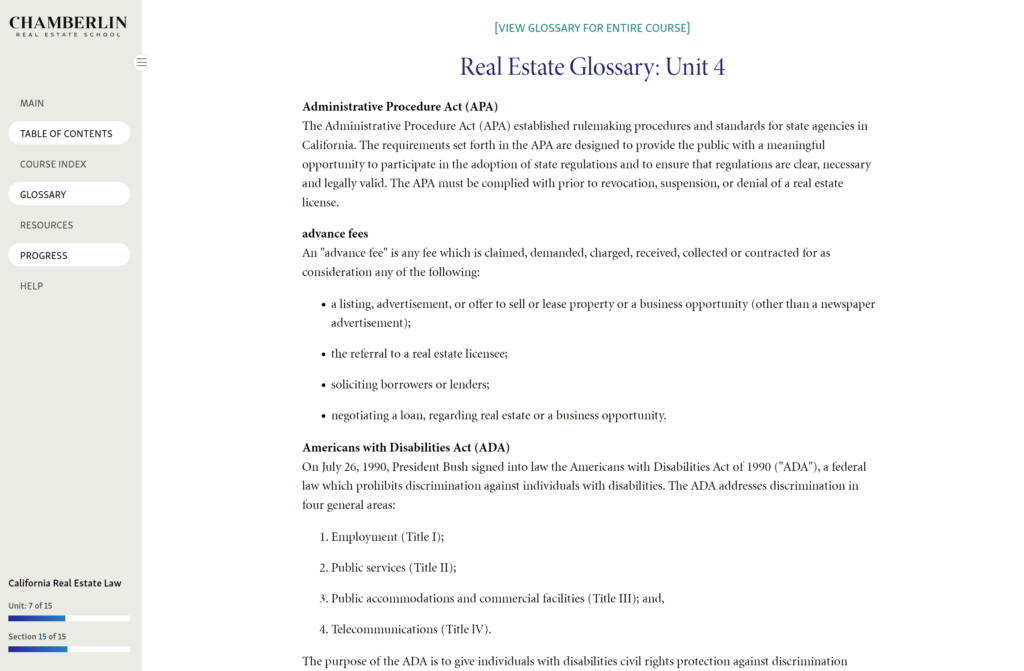
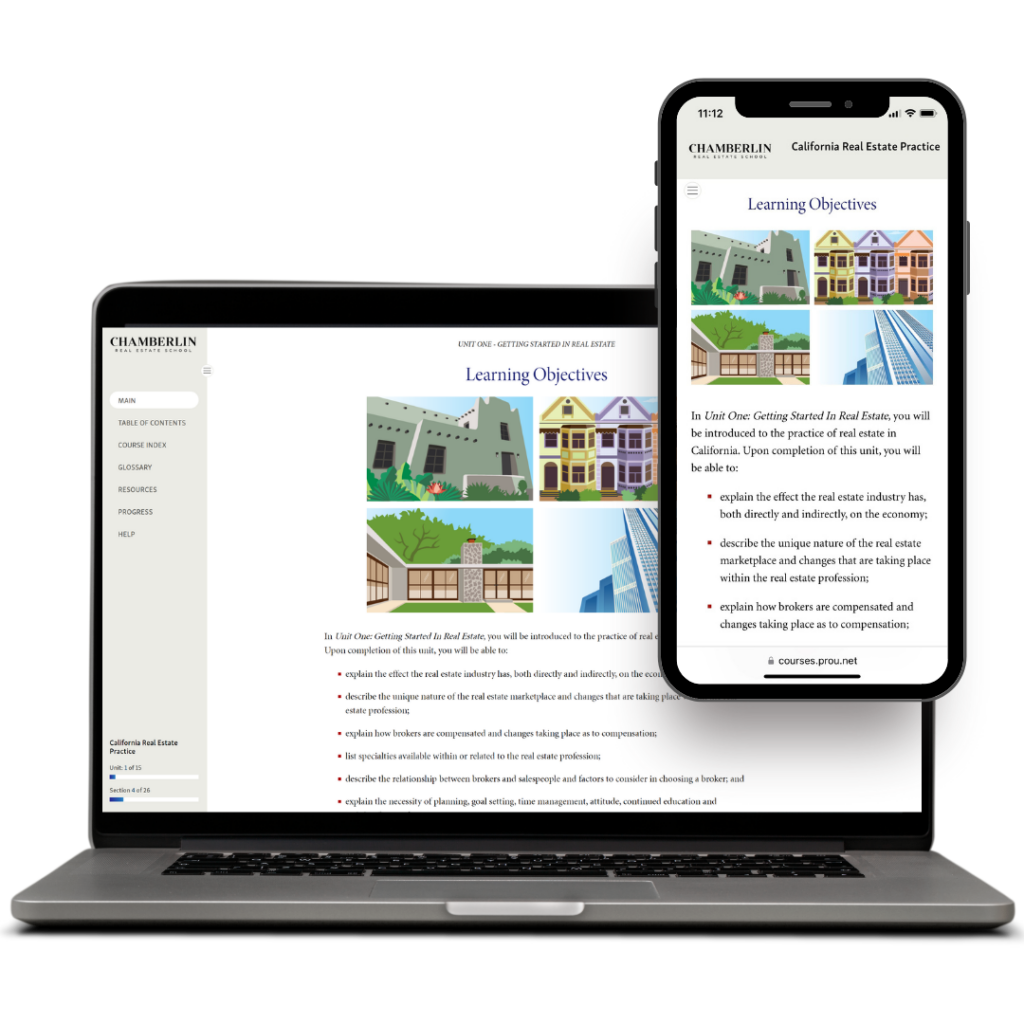
Features of our online courses:
- Start immediately upon enrollment
- Keeps track of your progress
- Brings you back to where you left off
- Final examination online - Open book
- Glossary of real estate terms in text and audio
- Links to real estate-related web sites
- Instant graded responses
- Personal instructor support
- Toll free technical support
*Physical textbooks are not necessary but may be ordered as a back-up to the online courses for an additional $40 each.
Broker License Process Questions
Important Note
Quite often people have completed courses from a past college degree, or from a past attempt to receive a Broker License, that will satisfy California Department of Real Estate requirements. If you completed a course, or several courses in the past, they should qualify as acceptable by providing the California Department of Real Estate with proof of completion.
Continuing education offerings do not satisfy the college-level course requirements for this examination.
Each college-level course must be a minimum of three semester-units or four quarter-units. The courses must be completed prior to being scheduled for an examination. Copies of official transcripts are generally acceptable evidence of completed courses. Transcripts of other courses, submitted as an equivalent course of study in lieu of the statutory courses, must be accompanied by an official course or catalog description in order to be evaluated.
Broker qualification courses must be completed at an institution of higher learning accredited by the Western Association of Schools and Colleges or by a comparable regional accrediting agency recognized by the United States Department of Education, or by a private real estate school which has had its courses approved by the California Real Estate Commissioner like Chamberlin Real Estate School (DRE Sponsor ID S0692).
Courses completed through foreign institutions of higher learning must be evaluated by a foreign credentials evaluation service approved by the Department of Real Estate.
Frequently Asked Questions (FAQs)
Yes, with one exception. All new potential brokers must complete a Real Estate Practice course that is compliant with State Bill 1495. Chamberlin is approved and offers the new compliant Practice course. The Real Estate Principles and elective course you took to get your Salesperson license will count towards the DRE required 8 courses.
Definitely. You can take the required classes either at an online real estate school or in person. However, all of your college-level real estate courses must be approved by the Department of Real Estate. Be sure to check with your educational institution and the Department of Real Estate before enrolling in any course to make sure it is approved.
The Department of Real Estate considers other kinds of equivalent experience, including experience as an escrow or title officer or loan officer in a capacity related to the financing or conveying of real estate, experience as a subdivider or speculative builder performing comprehensive duties related to the purchase, finance, development, and sale or lease of real estate, or experience as a real property appraiser. If you have any other form of equivalent experience, please contact the Department of Real Estate to find out if you are eligible for a broker’s license.
Yes, you can. California does not have a waiver program with any state, so you must apply for the real estate broker or salesperson examination and meet all the other requirements set by the Department of Real Estate.
You can verify if your out-of-state courses are accepted by submitting transcripts from accredited schools and colleges to the Department of Real Estate. Courses completed through foreign institutions of higher learning must be evaluated by a foreign credentials evaluation service approved by the Department of Real Estate.
Great news! Members of the State Bar do not have to complete college-level courses. Although, you would still need two years of full-time licensed salesperson experience or equivalent real estate experience while working as a lawyer in California.
No, your Juris Doctor degree is not enough. You would need to have taken college-level real estate classes and meet the other educational requirements set by the Department of Real Estate. Or, you must first pass the State Bar and meet the experience requirements while working as a lawyer in California.
Yes, but this is very rare. By 18, you either have to have been a licensed salesperson for at least two years or have finished a four-year degree under your belt. You can only be licensed as a salesperson from the age of 18, so you’ll need to wait two years before applying for a broker’s license.
However, the law also provides room for other types of real estate-related experience. if you have any form of experience related to real estate and have worked in the industry for more than two years, you may consider applying for a broker’s license. In addition, you will also have to fulfill the other educational requirements outlined by the Department of Real Estate.